

History of the Japanese Tea Ceremony: From Zen to Modern Kyoto
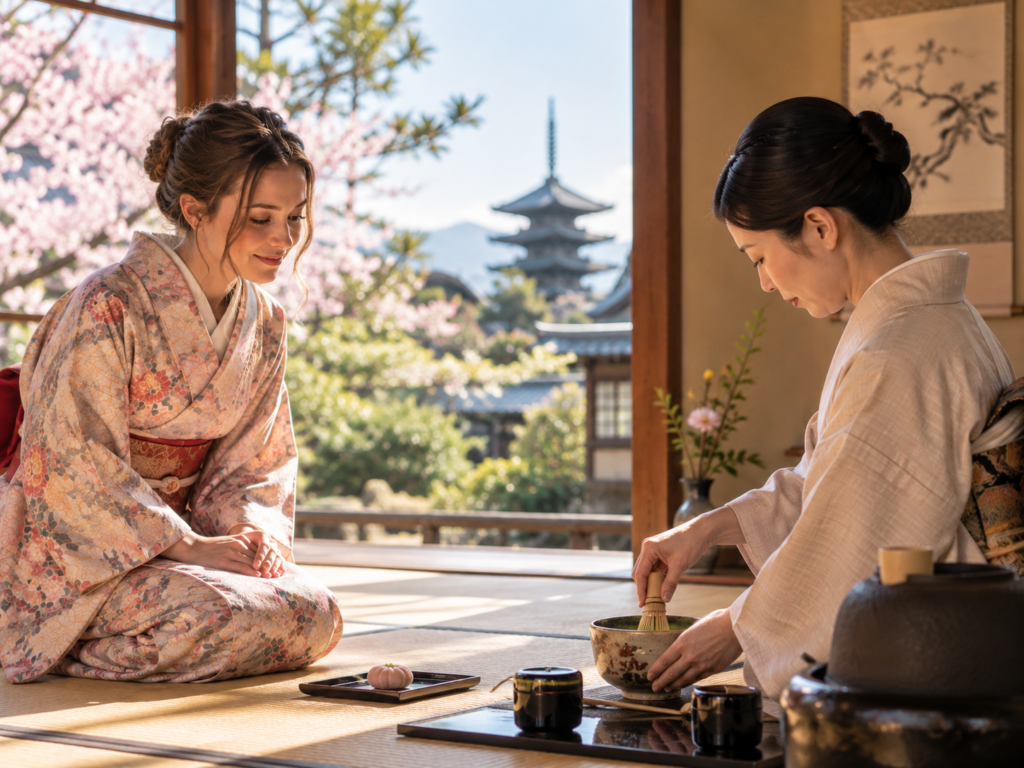
The Japanese tea ceremony is one of the most recognizable traditions in Japan.
A quiet tatami room.
A bowl of vivid green matcha.
A bamboo whisk.
Seasonal wagashi sweets.
Precise, graceful movements performed by the host.
Today, travelers from around the world come to Kyoto to experience this tradition for themselves. But the Japanese tea ceremony did not begin in the form we know today.
Tea itself did not even originate in Japan.
The history of the Japanese tea ceremony developed over centuries as tea traveled from China to Japan, became connected with Zen Buddhism, spread among samurai and powerful merchants, and eventually evolved into the refined culture of chanoyu, or “the way of tea.”
Figures such as Murata Juko, Takeno Joo, and especially Sen no Rikyu transformed the way tea was appreciated, placing greater value on simplicity, hospitality, and the unique moment shared between host and guest.
In this guide, we explore the history of the Japanese tea ceremony, from the arrival of tea in Japan to the culture visitors can experience in Kyoto today.
What Is the Japanese Tea Ceremony?
The Japanese tea ceremony is a traditional cultural practice centered around preparing and serving matcha.
But describing it simply as “making tea” misses much of its meaning.
The experience can include:
- The tea room
- Tatami flooring
- Tea bowls and utensils
- Seasonal flowers
- Hanging scrolls
- Wagashi sweets
- Matcha
- The movements of the host
- The interaction between host and guest
Each element contributes to the atmosphere of the gathering.
The Japanese tea ceremony is commonly called sado or chado, meaning “the way of tea.”
Another important term is chanoyu, literally meaning “hot water for tea.”
While these words can have slightly different nuances, international visitors will often encounter all three when learning about Japanese tea culture.
Most importantly, tea ceremony was not invented by a single person.
It developed gradually over more than a thousand years of Japanese history.
A Short History of the Japanese Tea Ceremony
Before looking at each period in detail, the development of Japanese tea culture can be simplified into the following timeline:
Tea arrives in Japan from China
↓
Tea is consumed mainly by monks and members of the aristocracy
↓
Zen monks help spread powdered tea culture
↓
Tea becomes popular among samurai and the elite
↓
A simpler aesthetic known as wabi-cha begins to develop
↓
Murata Juko and Takeno Joo influence its development
↓
Sen no Rikyu brings wabi-cha to its most influential form
↓
Different schools of tea ceremony develop
↓
Tea ceremony spreads more widely during the Edo period
↓
The tradition continues in modern Japan
Understanding this history makes many aspects of a modern tea ceremony easier to appreciate.
1. When Did Tea First Arrive in Japan?
The history of tea in Japan stretches back more than a thousand years.
Tea was introduced to Japan from China through cultural and religious exchanges, particularly during the Nara and early Heian periods.
At the time, China was a major cultural influence on Japan.
Japanese monks, scholars, and diplomatic missions traveled to China and returned with new ideas, religious teachings, objects, and customs.
Tea was among them.
However, tea was very different from the everyday beverage it would later become.
It was rare and valuable.
For much of its early history in Japan, tea was primarily associated with Buddhist monks, members of the imperial court, and other elite groups.
Tea culture as we know it today had not yet developed.
That transformation would come centuries later.
2. How Zen Buddhism Helped Spread Tea Culture
One of the most important figures in the early history of Japanese tea is the Zen Buddhist monk Eisai.
Eisai traveled to China during the Song dynasty to study Zen Buddhism.
When he returned to Japan, he helped promote both Zen teachings and tea culture.
He is also known for writing the Kissa Yojoki, often translated as “Drinking Tea for Health,” a work discussing the perceived health benefits of tea.
At this stage, tea was not prepared like the loose-leaf sencha commonly consumed in Japan today.
Tea leaves were processed into powder and mixed with hot water.
This method is an important ancestor of the matcha culture that later became central to Japanese tea ceremony.
Tea was valued not only for taste but also for its connection with health and Buddhist practice.
What Is the Connection Between Zen and Tea Ceremony?
Travelers learning about tea ceremony often encounter references to Zen.
There is a good historical reason.
Buddhist monks played an important role in transmitting and developing tea culture in Japan.
Tea was also useful in monasteries because it could help monks remain alert during long periods of meditation.
Over time, tea culture and Zen aesthetics influenced each other.
Zen practice emphasizes awareness of the present moment.
Similarly, tea ceremony encourages attention to simple actions:
Heating water.
Handling the tea bowl.
Preparing matcha.
Listening to the sound of water.
Watching the host.
Drinking the tea.
Rather than rushing toward a result, attention is given to the process itself.
It would be too simplistic to say that tea ceremony and Zen are the same thing. They are not.
However, Zen philosophy and aesthetics played an important role in the historical development of Japanese tea culture.
3. Tea Becomes Part of Samurai Culture
As tea became more established in Japan, it moved beyond Buddhist monasteries.
During the Kamakura and Muromachi periods, tea became increasingly popular among samurai, aristocrats, and powerful members of society.
Tea gatherings could be very different from the quiet tea ceremonies international visitors imagine today.
One popular form of entertainment was called tocha, a tea-tasting competition.
Participants would taste different teas and attempt to identify where they came from.
These gatherings could become elaborate social events, sometimes involving valuable prizes.
Tea was becoming entertainment.
It was also becoming a way to display wealth and status.
Tea as a Symbol of Wealth
Powerful people collected expensive objects imported from China.
These highly valued Chinese objects were known as karamono.
Tea bowls, paintings, ceramics, and other objects could be displayed during tea gatherings as demonstrations of wealth, taste, and social status.
The tea room could therefore become a place for showing prestige.
But Japanese tea culture would eventually move in another direction.
Instead of asking:
“How expensive is this object?”
Tea masters began exploring a different question:
“Can beauty exist in simplicity?”
That change became one of the most important developments in the history of Japanese tea ceremony.
4. Murata Juko and the Beginning of Wabi-Cha
One of the most important early figures in this transformation was Murata Juko, a tea master active during the Muromachi period.
Juko is closely associated with the development of wabi-cha.
Wabi-cha moved away from an exclusive focus on expensive Chinese objects and extravagant displays.
Instead, greater value was placed on simplicity, restraint, and spiritual depth.
An object did not need to be perfectly symmetrical.
A tea room did not need to be luxurious.
A simple Japanese-made tea bowl could possess its own beauty.
The experience of host and guest could matter more than the financial value of the objects surrounding them.
This represented a major change in Japanese tea culture.
The idea of finding beauty in simplicity would later become one of the qualities most strongly associated with Japanese aesthetics around the world.
5. Takeno Joo Further Develops Wabi-Cha
Another important figure in the development of tea ceremony was Takeno Joo.
Joo was a wealthy merchant from Sakai, an important commercial city in Japan.
He further developed the wabi-cha tradition that had emerged before him.
This created an interesting contrast.
Some of the people practicing a simple, restrained style of tea were themselves successful and wealthy merchants.
They could afford luxury.
Yet inside the tea room, simplicity could become more meaningful than extravagance.
Takeno Joo became an important influence on the man who would later become the most famous tea master in Japanese history:
Sen no Rikyu.
6. Who Was Sen no Rikyu?
If there is one name international visitors should know when learning about the history of Japanese tea ceremony, it is Sen no Rikyu.
Rikyu lived during the 16th century, one of the most politically turbulent periods in Japanese history.
He served powerful figures including Oda Nobunaga and Toyotomi Hideyoshi, two of the most important leaders of Japan’s Warring States period.
Despite his connections with powerful rulers, Rikyu became famous for developing an approach to tea that emphasized restraint and simplicity.
Small tea rooms.
Natural materials.
Simple utensils.
Quiet interaction.
Attention to the relationship between host and guest.
Through Rikyu, the philosophy and aesthetics of wabi-cha reached an extraordinarily influential form.
Did Sen no Rikyu Invent the Japanese Tea Ceremony?
No.
This is an important distinction.
Tea had existed in Japan for centuries before Rikyu was born, and earlier tea masters had already developed many of the ideas that influenced him.
Murata Juko and Takeno Joo, among others, were important figures in the development of wabi-cha.
Therefore, saying that Sen no Rikyu “invented” tea ceremony would be inaccurate.
His importance comes from how profoundly he refined and shaped wabi-cha, helping establish principles and aesthetics that continue to influence Japanese tea ceremony today.
7. Why Were Small Tea Rooms Important?
One striking feature associated with wabi-cha is the use of small, simple tea rooms.
For powerful samurai living in an age of castles, military conflict, and political ambition, entering a tiny tea room created a very different environment.
Social status could become less visible.
The focus shifted toward the gathering itself.
The host.
The guest.
The utensils.
The tea.
The present moment.
Even the entrance to some traditional tea rooms was intentionally small, requiring guests to lower themselves when entering.
The tea room created a space separated from ordinary life.
This is one reason even modern visitors can feel an immediate change in atmosphere when entering a traditional tatami tea room.
8. Ichigo Ichie: Treasure the Moment
One of the most famous ideas associated with Japanese tea culture is ichigo ichie.
The phrase is often translated as:
“One time, one meeting.”
Its deeper meaning is that a particular encounter should be treasured because the exact same moment will never happen again.
Imagine a tea gathering.
The same host may return tomorrow.
The same guest may return.
They might even use the same tea bowl and drink the same matcha.
But the season will be slightly different.
The weather may change.
The conversation will be different.
The people themselves will have changed.
That exact gathering can never be repeated.
This idea encourages both host and guest to appreciate the moment in front of them.
For travelers, it is also a beautiful way to think about experiencing tea ceremony in Kyoto.
Your tea ceremony becomes part of one particular day during one particular journey to Japan.
9. What Happened to Tea Ceremony After Sen no Rikyu?
Sen no Rikyu died in 1591, but his influence did not disappear.
His descendants and followers continued different tea traditions, and numerous schools of tea ceremony developed over time.
Three of the best-known schools today are collectively known as the San-Senke, or Three Sen Families:
Omotesenke
Urasenke
Mushakojisenke
Each has its own traditions, procedures, and characteristics.
There are also other schools of Japanese tea ceremony.
For first-time travelers, however, there is no need to memorize these differences before participating in a tea experience.
The more important point is that tea ceremony is not a frozen historical ritual.
It is a living tradition that has been taught from generation to generation.
10. Tea Ceremony During the Edo Period
During the Edo period, tea ceremony spread more widely throughout Japanese society.
It continued to be practiced by samurai and daimyo, but wealthy merchants and other groups also studied tea.
Different schools developed teaching systems and established their own traditions.
Tea ceremony increasingly became associated not only with social gatherings but also with cultural education and refinement.
By this point, the history of tea in Japan had already undergone a remarkable transformation:
Tea from China
↓
Tea among monks and elites
↓
Tea and Zen culture
↓
Tea among samurai
↓
Elaborate tea gatherings
↓
Wabi-cha
↓
A highly developed Japanese cultural tradition
Tea had become much more than a drink.
11. Why Is Kyoto So Important to Japanese Tea Culture?
Tea ceremony is practiced throughout Japan, but Kyoto occupies a particularly important place in its history.
For centuries, Kyoto was Japan’s imperial capital and one of the country’s major centers of religion, art, craftsmanship, and culture.
Temples, tea masters, craftspeople, merchants, and cultural leaders all contributed to the development of the tea world.
Tea culture also depends on many different traditional crafts.
Ceramics.
Bamboo utensils.
Lacquerware.
Textiles.
Calligraphy.
Flower arrangement.
Architecture.
Wagashi.
Kyoto became a place where many of these traditions could interact.
There is another important reason Kyoto is closely associated with tea:
Uji.
Uji and the History of Japanese Tea
Located south of central Kyoto, Uji is one of Japan’s most famous tea-producing areas.
Uji tea has a long history and remains internationally known for high-quality Japanese tea, including matcha.
The relationship between Kyoto and tea therefore extends beyond tea rooms.
It includes tea cultivation, craftsmanship, temples, sweets, utensils, and centuries of cultural development.
For international travelers, experiencing tea ceremony in Kyoto means participating in the tradition within one of the places most deeply connected to its history.
12. Why Are Wagashi Served With Matcha?
Visitors attending a tea ceremony in Kyoto will often receive a traditional Japanese sweet known as wagashi.
This is not simply an extra snack.
Matcha has a distinctive bitterness.
Eating something sweet before drinking matcha creates a pleasant contrast between sweetness and bitterness.
But wagashi also has an aesthetic role.
Traditional Japanese sweets often express the season.
Spring might be represented by cherry blossoms.
Summer designs may suggest cool water.
Autumn may appear through maple leaves or seasonal colors.
Winter sweets may evoke snow.
In tea culture, the season can also appear in the flowers, hanging scroll, tea bowl, and other utensils chosen by the host.
The goal is not simply to serve tea.
The entire environment can reflect a particular moment in the year.
13. Why Are Tea Bowls and Utensils So Important?
First-time visitors sometimes wonder why tea bowls and utensils are handled with such care.
In tea ceremony, utensils are part of the cultural experience.
Important objects may include:
Chawan — tea bowl
Chasen — bamboo tea whisk
Chashaku — bamboo tea scoop
Natsume — container used for powdered tea
Kama — iron kettle
Each object has a purpose.
But tea utensils can also be appreciated aesthetically.
A tea bowl does not necessarily need to be perfectly shaped or elaborately decorated to be considered beautiful.
A slightly irregular form.
The natural texture of clay.
An unexpected glaze.
Signs of age and use.
These characteristics can contribute to the personality of an object.
The way tea culture values such details offers visitors an introduction to a broader Japanese appreciation for subtlety, imperfection, and craftsmanship.
14. How Is Japanese Tea Ceremony Practiced Today?
Tea ceremony remains a living tradition in modern Japan.
Some people study tea for many years under experienced teachers.
Others participate through schools, universities, cultural organizations, temples, or community activities.
Formal tea gatherings also continue to take place.
At the same time, international tourism has created another way for people to encounter the tradition.
Today, visitors to Kyoto can participate in tea ceremony experiences designed specifically for beginners.
These experiences are not necessarily the same as a full formal chaji, which can last several hours and may involve a meal, thick tea, thin tea, and a highly structured sequence.
Instead, beginner-friendly experiences introduce important elements of tea culture in an accessible format.
Visitors may learn about tea ceremony, observe the host preparing matcha, taste wagashi, and sometimes prepare their own bowl of tea.
For someone visiting Japan for the first time, this can be an excellent introduction to the culture.
15. Understanding the History Makes Tea Ceremony More Meaningful
You do not need to study Japanese history before joining a tea ceremony.
But knowing even a little of the background can completely change what you notice.
Why is the tea room so simple?
Why does the host move so carefully?
Why are the utensils treated with respect?
Why are seasonal sweets served?
Why is so much attention given to preparing a single bowl of tea?
These details are easier to understand when you realize that tea ceremony developed over centuries.
The bowl of matcha in front of you is connected to monks who brought tea culture from China.
To Zen monasteries.
To samurai gatherings.
To merchants and tea masters.
To Murata Juko.
To Takeno Joo.
To Sen no Rikyu.
And to generations of people who continued practicing tea culture after them.
Experience the History of Japanese Tea Ceremony in Kyoto
You can learn a great deal about Japanese tea ceremony through books, museums, and articles.
But tea ceremony is ultimately something experienced through the senses.
Step onto tatami.
Listen to the sound of water.
Watch the host handle the utensils.
See the matcha powder inside the tea bowl.
Taste a seasonal Japanese sweet.
Watch the bamboo whisk move quickly through the tea.
Hold the finished bowl in your hands.
Drink the matcha.
These small actions make centuries of Japanese culture feel much more tangible.
And Kyoto is one of the best places to experience them.
Experience Japanese Tea Culture at THE TEA CEREMONY GION Orizuruya
Located in historic Gion, THE TEA CEREMONY GION Orizuruya introduces visitors to Japanese tea culture through a hands-on tea ceremony experience.
Orizuruya is approximately 4 minutes on foot from Gion-Shijo Station and 7 minutes from Kyoto-Kawaramachi Station, making it easy to include in a day exploring Gion.
Rather than simply receiving a finished bowl of matcha, guests can learn about tea culture, watch the preparation process, and use a traditional bamboo chasen to whisk matcha themselves.
Matcha can also be enjoyed together with Kyoto wagashi.
For international visitors, the experience offers an opportunity to move beyond simply reading about Japanese traditions.
You can see the utensils.
Hear the sounds of the tea room.
Taste matcha.
Use the whisk yourself.
And experience a small part of a cultural tradition that has developed over centuries.
Frequently Asked Questions About Japanese Tea Ceremony History
Who invented the Japanese tea ceremony?
No single person invented the Japanese tea ceremony.
Tea culture developed in Japan over many centuries.
Figures including Murata Juko, Takeno Joo, and Sen no Rikyu played particularly important roles in the development of wabi-cha.
Sen no Rikyu is often considered the most influential tea master in Japanese history, but tea culture existed long before his lifetime.
When did tea first arrive in Japan?
Tea was introduced from China through cultural and religious exchanges more than a thousand years ago.
Early tea consumption in Japan was particularly associated with monks and elite members of society.
Did matcha originate in Japan?
The practice of consuming powdered tea came to Japan from China.
Japan subsequently developed its own distinctive traditions of cultivating, producing, preparing, and appreciating powdered tea, eventually giving rise to the matcha culture known around the world today.
Who was Sen no Rikyu?
Sen no Rikyu was a highly influential 16th-century Japanese tea master.
He played a major role in refining and establishing the aesthetics of wabi-cha and served powerful historical figures including Oda Nobunaga and Toyotomi Hideyoshi.
What is wabi-cha?
Wabi-cha is an approach to tea culture that emphasizes simplicity, restraint, humility, and appreciation beyond obvious luxury.
It became enormously influential in the development of Japanese tea ceremony.
What does ichigo ichie mean?
Ichigo ichie can be translated as “one time, one meeting.”
It expresses the idea that each encounter is unique and should be treasured because exactly the same moment will never happen again.
Is Japanese tea ceremony related to Zen Buddhism?
Yes, there is a strong historical connection.
Zen monks played an important role in the spread of tea culture in Japan, and Zen thought and aesthetics influenced the later development of tea ceremony.
However, Zen Buddhism and tea ceremony should not be treated as exactly the same thing.
Why is Kyoto famous for tea ceremony?
Kyoto was one of Japan’s most important historical centers of religion, art, craftsmanship, and culture.
The Kyoto region is also home to Uji, one of Japan’s most famous tea-producing areas.
Together, these factors have made Kyoto deeply connected with Japanese tea culture.
Can foreigners experience a tea ceremony in Kyoto?
Yes.
Kyoto offers tea ceremony experiences designed for international travelers and complete beginners.
No previous knowledge of tea ceremony is necessary when choosing a beginner-friendly experience.
Discover More Than 1,000 Years of Tea Culture in Kyoto
The history of Japanese tea ceremony begins with tea arriving from China more than a thousand years ago.
Monks drank tea.
Zen culture helped it spread.
Samurai turned tea into an important form of social interaction.
Tea masters began finding beauty in simplicity.
Murata Juko and Takeno Joo helped develop wabi-cha.
Sen no Rikyu refined it into one of the most influential cultural traditions in Japanese history.
Later generations continued to teach and transform the practice.
And today, visitors from around the world can sit inside a tea room in Kyoto and experience part of that history themselves.
A bowl of matcha may look simple.
But behind it are centuries of religion, craftsmanship, hospitality, aesthetics, and human connection.
When you visit Kyoto, do not only learn about Japanese tea ceremony from the outside.
Step inside the tea room.
Pick up the bamboo whisk.
Prepare matcha.
And become part of the continuing story of Japanese tea culture.
Experience the history and spirit of Japanese tea ceremony at THE TEA CEREMONY GION Orizuruya.