

Japanese Tea Ceremony Etiquette for Beginners: How to Drink Matcha and What to Expect
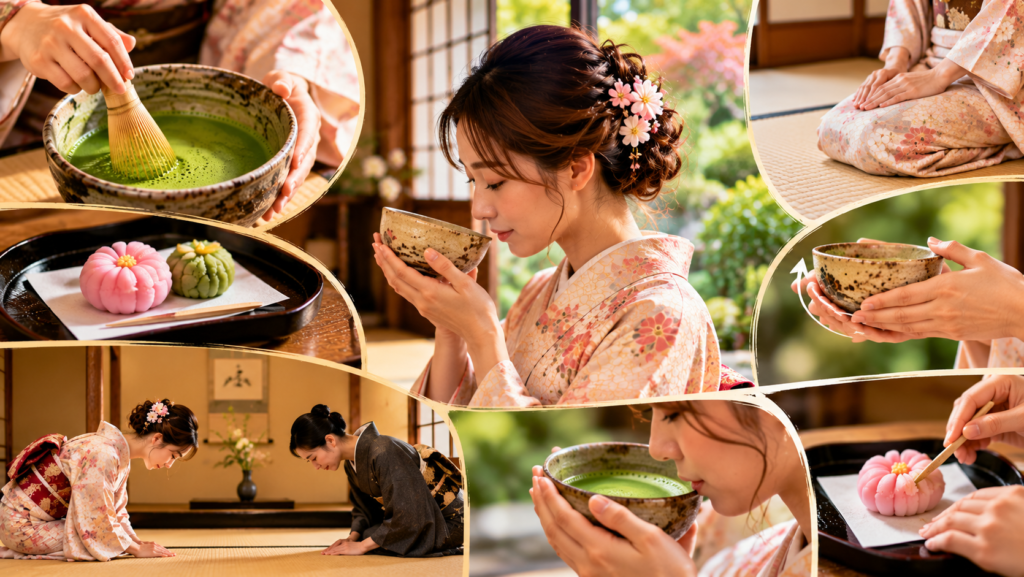
Planning to join a Japanese tea ceremony in Kyoto but worried about making a mistake?
You are not alone.
Many first-time visitors have the same questions.
Do I need to bow?
Why do people turn the tea bowl?
Should I eat the Japanese sweets before drinking matcha?
What if I cannot sit on my knees?
And what happens if I accidentally break one of the rules?
The good news is that you do not need to memorize complicated etiquette to enjoy your first Japanese tea ceremony.
Traditional tea ceremony has many customs, but beginner-friendly experiences are designed to help visitors understand them step by step.
The most important thing is not performing every movement perfectly.
It is showing respect for your host, appreciating the tea, and enjoying the moment.
In this guide, we explain Japanese tea ceremony etiquette for beginners, including how to drink matcha, why you turn the tea bowl, when to eat wagashi, what to wear, and what to expect during your first tea ceremony in Kyoto.
What Is Japanese Tea Ceremony Etiquette?
Japanese tea ceremony, also known as chanoyu or sado, is a traditional practice centered on preparing and serving matcha.
But it is much more than simply making tea.
A tea ceremony brings together Japanese hospitality, traditional utensils, seasonal aesthetics, architecture, and carefully considered movements.
The host prepares tea for the guests, while the guests receive it with appreciation and respect.
Tea ceremony etiquette helps create this atmosphere.
For example:
- Bowing expresses respect and gratitude.
- Handling the tea bowl carefully shows appreciation for the utensils.
- Eating wagashi before matcha allows you to enjoy the contrast of flavors.
- Following the host’s guidance helps everyone share the experience comfortably.
The purpose of etiquette is not to make visitors nervous.
It is to make the experience more thoughtful and meaningful.
Do all Japanese tea ceremonies follow the same rules?
No.
Japan has several tea ceremony schools, and some details of etiquette differ between them.
Even within the same tradition, the procedures can vary depending on the type of gathering.
For beginners, the best approach is simple:
Follow the instructions of your host rather than trying to memorize one universal set of rules.
What Happens During a Japanese Tea Ceremony?
Before learning specific etiquette, it helps to understand the general flow of a beginner-friendly tea ceremony.
A typical tourist experience may include:
- Entering the tea room
- Learning about Japanese tea culture
- Watching the host demonstrate tea preparation
- Enjoying traditional Japanese sweets
- Receiving and drinking matcha
- Learning about the tea bowl and utensils
- Preparing your own matcha using a bamboo whisk
The exact order and activities vary by venue.
Some experiences focus on observing the host, while others include more hands-on participation.
At THE TEA CEREMONY GION Orizuruya in Kyoto, visitors can experience traditional tea culture, enjoy Kyoto wagashi, and prepare matcha themselves using a bamboo chasen.
Explore the Tea Ceremony Experience in Kyoto
1. How to Enter a Japanese Tea Room
Your tea ceremony begins before you drink the first sip of matcha.
Entering the tea room calmly and respectfully helps establish the atmosphere.
Remove your shoes
Traditional Japanese tea rooms often have tatami flooring.
You will generally be asked to remove your shoes before entering.
Follow the venue’s instructions and keep your shoes neatly arranged where appropriate.
Enter quietly
Avoid rushing into the room or speaking loudly.
Tea ceremony encourages attention to your surroundings.
Notice the tatami, the tea utensils, the decorations, and the atmosphere.
Do not touch the utensils without permission
You may see beautiful ceramic bowls, bamboo tools, scrolls, or flower arrangements.
These objects may be delicate or valuable.
Wait for your host to invite you to handle or examine them.
2. Do You Have to Kneel During a Japanese Tea Ceremony?
One of the most common concerns among international visitors is sitting in seiza, the traditional Japanese kneeling position.
In seiza, you kneel on the floor with your legs folded beneath you.
This posture is traditionally associated with formal tea gatherings.
However, not every beginner-friendly tea ceremony requires guests to remain in seiza throughout the experience.
Some venues offer chairs or alternative seating arrangements.
What if I cannot sit in seiza?
If you have knee problems, limited mobility, or difficulty sitting on the floor, contact the venue before booking.
Ask whether chairs or other seating options are available.
Do not force yourself into a painful position simply because you think it is required.
What if my legs become numb?
This can happen even to people who are familiar with sitting on tatami.
If you become uncomfortable, let your host or instructor know.
A beginner-friendly experience should allow you to focus on learning about Japanese culture rather than worrying about physical discomfort.
3. When Should You Eat Wagashi During a Tea Ceremony?
During many Japanese tea ceremonies, guests are served traditional Japanese sweets called wagashi.
These sweets are an important part of Japanese tea culture.
They may reflect the season through their ingredients, colors, shapes, or names.
Do you eat wagashi before or after matcha?
In a typical thin-tea service, wagashi is eaten before drinking matcha.
The sweetness of the confection creates a pleasant contrast with the bitterness and umami of the tea.
For example, you might enjoy a delicate seasonal sweet before receiving a bowl of freshly prepared matcha.
The combination allows you to appreciate both flavors.
How do you eat wagashi properly?
In more formal tea gatherings, guests may use special paper called kaishi and a small sweet-cutting utensil.
However, beginner-friendly experiences may provide sweets in a simpler way.
Your host will explain what to do.
Do you have to eat the sweet in one bite?
No.
Depending on the type and size of the sweet, you can divide it into smaller pieces.
The important thing is to follow the instructions provided during the experience.
4. How to Drink Matcha During a Japanese Tea Ceremony
This is the part many first-time visitors worry about most.
How exactly are you supposed to drink matcha?
Although specific procedures differ between tea schools, the following steps provide a useful introduction to a typical thin-tea service.
Step 1: Receive the tea bowl
When the tea is served, receive the bowl carefully.
The bowl is often held with one hand supporting its base and the other hand gently stabilizing it.
Treat the bowl as a piece of craftsmanship rather than an ordinary cup.
Step 2: Express gratitude
Tea ceremony places importance on appreciation.
Depending on the tradition, you may bow or use a short phrase to thank the host.
You may also acknowledge the other guests.
Do not worry about memorizing formal Japanese expressions before arriving.
Your host will guide you.
Step 3: Turn the tea bowl
In many tea ceremony traditions, guests turn the bowl slightly before drinking.
This is one of the most recognizable aspects of Japanese tea ceremony etiquette.
The movement is connected to the idea of avoiding the decorative front of the bowl.
We will explain the meaning in more detail below.
Step 4: Drink the matcha
Lift the bowl toward your mouth and drink the tea.
In a typical thin-tea service, guests usually drink the matcha in a few sips.
You do not need to obsess over an exact number of sips.
Follow your host’s guidance and enjoy the flavor.
Step 5: Clean the rim if instructed
In some traditions, guests wipe the part of the bowl where their lips touched it.
The precise method varies.
If your host demonstrates this step, follow their instructions.
Step 6: Return the bowl
After drinking, you may be asked to rotate the bowl back to its original orientation before placing it down.
Set it down carefully and quietly.
Remember that the bowl may be handmade and delicate.
5. Why Do You Turn the Tea Bowl in a Japanese Tea Ceremony?
If you have watched videos of Japanese tea ceremonies, you may have noticed guests rotating the bowl before drinking.
This movement can seem unusual to first-time visitors.
But it has a cultural meaning.
What is the front of a tea bowl?
Some Japanese tea bowls have a decorative front, known as the shomen.
This may be the side with a distinctive design, glaze pattern, or other visual feature.
The host may present the bowl with its front facing the guest.
Why avoid drinking from the front?
In many tea ceremony traditions, guests turn the bowl so they do not drink directly from its decorative front.
This gesture expresses respect for the bowl and appreciation for the host.
It reflects a broader principle of tea ceremony:
The utensils are not merely tools. They are part of the cultural experience.
How many times should you turn the bowl?
You may have heard that you should turn the bowl twice.
However, the exact movement, direction, and number of turns can differ between schools.
Rather than memorizing a fixed rule, follow the instructions given during your experience.
Which direction should you turn the tea bowl?
There is no single instruction that applies universally to every tea school and every setting.
Your instructor will demonstrate the appropriate method.
For beginners, understanding why the bowl is turned is more valuable than memorizing an isolated movement.
6. How to Bow During a Japanese Tea Ceremony
Bowing is an important part of Japanese etiquette, including tea ceremony.
It expresses respect, gratitude, and consideration for others.
You may bow when:
- Greeting the host
- Receiving tea
- Thanking the host
- Acknowledging another guest
- Leaving the tea room
The depth and timing of bows depend on the situation and tradition.
Do you need to know formal Japanese phrases?
Not necessarily.
However, you may hear expressions such as:
Osaki ni (お先に)
A polite expression used when receiving tea before another guest.
Otemae chodai itashimasu (お点前頂戴いたします)
A traditional expression of appreciation before receiving tea.
You do not need to memorize these phrases before joining a beginner-friendly experience.
Understanding their meaning is enough to appreciate the intention behind them.
7. What Should You Wear to a Japanese Tea Ceremony?
Many travelers assume they must wear a kimono to participate in a tea ceremony.
That is not necessarily true.
Many beginner-friendly tea ceremony experiences welcome guests wearing ordinary clothing.
However, choosing appropriate clothing can help you feel more comfortable.
Wear comfortable clothes
If you will sit on tatami, choose clothing that allows you to sit and move comfortably.
Avoid strong perfume
Matcha has a delicate aroma.
Strong fragrances may interfere with other guests’ enjoyment of the tea.
Be careful with jewelry
Large rings, watches, or bracelets can potentially scratch ceramic tea bowls.
Some venues may ask guests to remove certain accessories.
Bring clean socks if required
Traditional tatami rooms may require guests to wear socks.
Check the venue’s instructions before arriving.
Can you wear a kimono?
Yes, if the venue allows it.
Combining kimono with tea ceremony can be a memorable way to experience two Japanese traditions during your Kyoto visit.
8. Common Japanese Tea Ceremony Mistakes to Avoid
You do not need perfect etiquette, but a few simple precautions will help you participate respectfully.
Touching utensils without permission
Wait until the host invites you to examine or handle tea utensils.
Speaking loudly during the ceremony
Tea ceremony often emphasizes a calm atmosphere.
Follow the tone of the gathering.
Taking photographs without asking
Photography rules vary between venues.
Some experiences allow photographs at designated moments, while others restrict photography during demonstrations.
Always ask first.
Wearing strong perfume
Avoid fragrances that could interfere with the aroma of the tea.
Treating the ceremony only as a photo opportunity
Taking photographs can be part of a travel experience, but try to remain present.
Watch the host.
Notice the utensils.
Taste the matcha.
Appreciate the setting.
Worrying too much about making mistakes
This is perhaps the most unnecessary concern for beginners.
If you make a small mistake, simply follow the host’s guidance.
You are participating in an experience designed to help you learn.
9. Are Tea Ceremony Rules Different Between Schools?
Yes.
Japanese tea ceremony has several schools with distinct traditions.
Three of the best-known are:
Omotesenke
Urasenke
Mushakojisenke
These schools share important historical roots but differ in aspects of tea preparation, etiquette, and presentation.
For example, the appearance of prepared thin tea and certain movements may vary between schools.
This is why online instructions sometimes seem contradictory.
One guide may recommend a particular way of turning the bowl, while another describes a different method.
Both may reflect legitimate traditions.
For visitors, the best approach is to respect the procedures taught by the host.
10. Do You Need to Learn Tea Ceremony Etiquette Before Visiting Kyoto?
No.
Learning a few basic customs can help you feel more confident, but you do not need extensive preparation.
If you are visiting Kyoto and want to experience Japanese tea culture, look for a beginner-friendly program.
A good introductory experience should explain:
What tea ceremony is
Why certain movements are performed
How to handle the tea bowl
When to eat wagashi
How to drink matcha
How to use a bamboo whisk
The experience should feel educational rather than intimidating.
What should you look for when booking?
Consider the following questions.
Is the experience suitable for beginners?
Check whether the program is designed for first-time visitors.
Can you prepare matcha yourself?
Hands-on participation can make the experience more memorable.
How long does the experience last?
Choose a duration that fits your sightseeing itinerary.
Is English guidance available?
If you do not speak Japanese, check the language options before booking.
Are there seating accommodations?
If you cannot sit in seiza, ask about alternative seating.
11. Where to Experience a Japanese Tea Ceremony in Kyoto
Kyoto is one of the most rewarding places to experience Japanese tea culture.
The city’s history, architecture, traditional arts, and relationship with tea make it a natural destination for travelers interested in chanoyu.
Several neighborhoods offer tea ceremony experiences, but Gion is particularly appealing for visitors who want to combine traditional culture with sightseeing.
You can explore historic streets, visit temples and shrines, enjoy Japanese cuisine, and participate in a tea ceremony within the same area.
A simple Gion itinerary
10:00 AM — Visit Kennin-ji Temple
Explore one of Kyoto’s historic Zen temples.
11:00 AM — Walk through Gion
Discover traditional streets and wooden architecture.
12:00 PM — Lunch
Enjoy a meal in the neighborhood.
1:00 PM — Japanese Tea Ceremony
Learn about tea culture, enjoy wagashi, and prepare matcha.
2:30 PM — Visit Yasaka Shrine
Continue exploring Gion’s cultural landmarks.
This creates a balanced day combining sightseeing with hands-on Japanese culture.
12. Experience Japanese Tea Ceremony at THE TEA CEREMONY GION Orizuruya
Located in Kyoto’s historic Gion district, THE TEA CEREMONY GION Orizuruya offers Japanese cultural experiences for visitors interested in learning about traditional tea culture.
The venue is approximately 4 minutes on foot from Gion-Shijo Station and 7 minutes from Kyoto-Kawaramachi Station.
Its location makes it convenient to combine a tea ceremony with sightseeing around Gion.
What can you experience?
During the standard tea ceremony experience, guests can:
Learn about Japanese tea culture.
Watch the host demonstrate traditional tea preparation.
Discover Japanese tea utensils.
Enjoy Kyoto wagashi.
Use a bamboo chasen to prepare matcha.
Taste the matcha they have prepared.
The experience allows visitors to learn about tea ceremony through observation and participation.
Do beginners need to know etiquette in advance?
No.
You do not need to memorize how many times to turn the tea bowl or learn formal Japanese phrases before joining a beginner-friendly tea ceremony.
Instead, you can learn about these customs during the experience.
Other Japanese cultural experiences
For visitors interested in exploring more than one Japanese tradition, Orizuruya also offers programs combining Japanese calligraphy and tea ceremony.
Travelers interested in Kyoto’s traditional entertainment culture can explore a tea ceremony experience involving a real maiko.
Explore the experiences:
Frequently Asked Questions About Japanese Tea Ceremony Etiquette
Do tourists need to know Japanese tea ceremony etiquette?
No. Beginner-friendly tea ceremony experiences are designed for people with little or no previous knowledge. Your host will explain the necessary customs.
How do you drink matcha properly during a tea ceremony?
In many traditions, you receive the bowl carefully, express gratitude, rotate it to avoid drinking from its decorative front, drink the tea in a few sips, and return the bowl respectfully. Exact procedures vary by tea school.
Why do you turn the tea bowl before drinking?
In many tea ceremony traditions, guests rotate the bowl to avoid drinking directly from its decorative front. This is a gesture of respect for the bowl and the host.
How many times should you turn the tea bowl?
There is no single universal rule. The number and direction of turns depend on the tea school and setting. Follow your host’s instructions.
Do you eat wagashi before drinking matcha?
Yes. In a typical thin-tea service, wagashi is eaten before matcha. The sweetness complements the tea’s bitterness and umami.
Do you have to kneel during a Japanese tea ceremony?
Not always. Some beginner-friendly venues offer chairs or alternative seating. Contact the venue in advance if sitting in seiza is difficult.
Can you wear normal clothes to a tea ceremony?
Yes. Many tourist-oriented tea ceremonies allow everyday clothing. Comfortable clothes, clean socks when required, and minimal jewelry are sensible choices.
Is it rude to make a mistake during a tea ceremony?
Beginners are not expected to perform every movement perfectly. Follow your host’s guidance, handle the utensils respectfully, and remain attentive.
Can you take photos during a tea ceremony?
Photography policies vary by venue. Ask permission before taking photographs, particularly during demonstrations.
Can you join a tea ceremony without speaking Japanese?
Yes. Some tea ceremony experiences in Kyoto provide English-language guidance or programs designed for international visitors. Confirm language availability when booking.
The Most Important Tea Ceremony Rule: Respect the Moment
Japanese tea ceremony etiquette may seem complicated at first.
Bowing.
Turning the bowl.
Eating wagashi.
Handling utensils.
Sitting correctly.
Using traditional expressions.
But these customs share a common purpose.
They encourage appreciation for the host, the tea, the utensils, and the people sharing the experience.
You do not need to master them before your first tea ceremony.
You only need curiosity, respect, and a willingness to learn.
When you visit Kyoto, consider stepping into a tea room and experiencing the tradition for yourself.
Watch the host.
Taste the wagashi.
Hold the tea bowl.
Whisk your own matcha.
And enjoy a moment that is different from ordinary sightseeing.
The best way to understand Japanese tea ceremony etiquette is not simply to read about it. It is to experience it.