

Japanese Calligraphy Experience in Kyoto: Shodo for Beginners
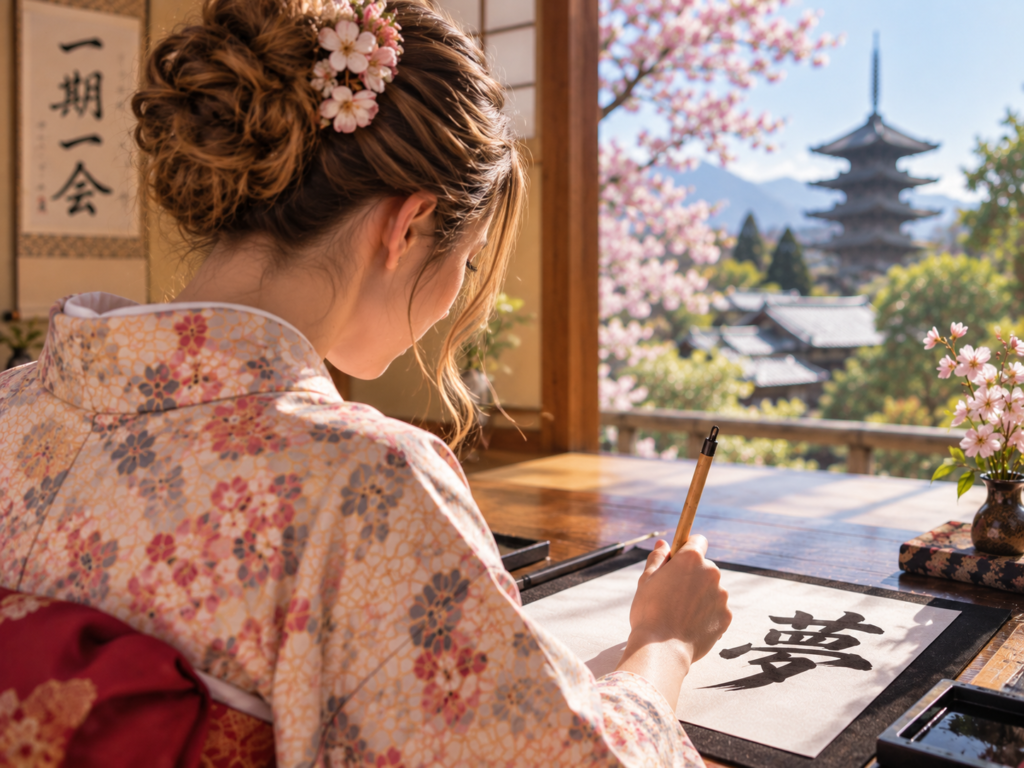
If you want to do more than simply see Japanese culture during your trip to Kyoto, a Japanese calligraphy experience is an excellent way to participate in it.
Hold a brush.
Dip it into black ink.
Choose a meaningful Japanese character.
Slowly place the brush onto the paper.
At first, writing with a traditional brush may feel unfamiliar. The angle of your hand, the amount of pressure, and the speed of each movement can completely change the appearance of a single line.
That is part of what makes shodo, or Japanese calligraphy, so fascinating.
Calligraphy is not only about writing readable characters.
It is also about rhythm, balance, movement, empty space, and personal expression.
For international visitors, a calligraphy experience in Kyoto offers something especially memorable: you can create your own piece of Japanese culture and take the memory of that experience home with you.
In this guide, we explain what Japanese calligraphy is, what happens during a shodo experience, which kanji are popular for beginners, and why combining calligraphy with tea ceremony can be one of the best cultural experiences in Kyoto.
What Is Japanese Calligraphy?
Japanese calligraphy is called shodo, meaning “the way of writing.”
It is a traditional art of writing Japanese characters with a brush and ink.
In English, it is usually called:
Japanese calligraphy
or
Shodo
But shodo is more than handwriting.
The appearance of a character can change depending on:
- Brush pressure
- Brush angle
- Speed
- Ink
- Stroke direction
- Balance
- Empty space
- The personality of the writer
This means two people can write the same kanji and produce completely different works.
For this reason, Japanese calligraphy can be understood as both writing and visual art.
1. A Short History of Japanese Calligraphy
The history of Japanese calligraphy is closely connected to the introduction of Chinese characters to Japan.
Japan originally did not have the same written system used today.
Chinese writing, along with Buddhist texts and other cultural influences, entered Japan from the Asian continent.
Over time, Japanese people adapted Chinese characters, or kanji, to the Japanese language.
Japan also developed its own phonetic scripts, including hiragana and katakana.
During the Heian period, elegant styles of writing became especially important among members of the imperial court and aristocracy.
Calligraphy later continued to develop through temples, samurai culture, scholars, artists, and different schools of writing.
Today, shodo remains a familiar part of Japanese life.
Many Japanese students experience brush calligraphy in school, while serious practitioners may spend many years studying it as an art.
This combination of everyday familiarity and traditional artistry is one reason shodo remains such an important part of Japanese culture.
2. Why Experience Calligraphy in Kyoto?
You can try Japanese calligraphy in different parts of Japan, but Kyoto is especially well suited to the experience.
For more than a thousand years, Kyoto has been one of Japan’s most important centers of religion, art, literature, craftsmanship, and traditional culture.
As you explore Kyoto, you will encounter brush writing almost everywhere.
Temple calligraphy.
Hanging scrolls.
Traditional shop signs.
Noren curtains.
Goshuin temple and shrine stamps.
Japanese artworks.
Tea room decorations.
After seeing these forms of writing around the city, holding a brush yourself creates a much deeper connection with what you have been seeing.
Instead of only observing Japanese culture, you become part of it.
3. Can Beginners and Foreign Visitors Try Shodo?
Absolutely.
You do not need to speak Japanese.
You do not need to read kanji.
And you do not need any previous calligraphy experience.
In fact, shodo can be particularly interesting for people who have never written Japanese before.
A beginner-friendly calligraphy experience usually teaches you how to hold the brush and how to make basic strokes before you begin your final work.
You can look at the shape of a character and practice reproducing it.
For international visitors, this creates a different relationship with Japanese writing.
Instead of thinking only about what the character says, you begin noticing how it looks:
The direction of each stroke.
The balance between left and right.
The thickness of a line.
The space between different parts of the character.
Kanji becomes visual art.
4. What Happens During a Japanese Calligraphy Experience?
The exact format depends on the venue, but a beginner calligraphy experience often follows a simple process.
First, you learn a little about Japanese calligraphy and its tools.
Then you practice holding the brush.
You try basic strokes.
Next, you select a kanji or word you would like to write.
You practice the character several times.
Finally, you create your finished piece.
The first attempt may not look the way you imagined.
That is normal.
Using a brush is very different from using a pen.
As you practice, however, you begin to understand how the brush reacts to pressure and movement.
Comparing your first attempt with your final piece can be one of the most satisfying parts of the experience.
5. What Tools Are Used in Japanese Calligraphy?
Traditional Japanese calligraphy uses several important tools.
Four of the most famous are sometimes referred to as the Four Treasures of the Study.
Brush — Fude
The brush is used to create each stroke.
Changing the pressure allows the writer to produce both thin and thick lines.
The brush can also create expressive variations that are difficult to reproduce with an ordinary pen.
Ink — Sumi
Traditional black ink is called sumi.
Historically, solid ink sticks were rubbed with water on an inkstone to create liquid ink.
Prepared liquid ink is also commonly used today.
Inkstone — Suzuri
A suzuri is an inkstone used for grinding ink and holding the liquid ink.
Paper — Kami
Japanese calligraphy uses absorbent paper.
Because the ink quickly enters the paper, each brush movement matters.
Once a stroke has been made, it cannot simply be erased.
This gives every movement a sense of immediacy.
6. What Kanji Should You Write?
One of the most enjoyable parts of a Japanese calligraphy experience is choosing a character with a meaning you like.
Popular options include:
愛 — Ai — Love
夢 — Yume — Dream
心 — Kokoro — Heart / Mind / Spirit
和 — Wa — Harmony / Japan
幸 — Sachi or Ko — Happiness / Good fortune
道 — Do / Michi — Way / Path
空 — Sora / Ku — Sky / Emptiness
美 — Bi — Beauty
侍 — Samurai
You may choose a character because of its meaning.
You may like its appearance.
Or you may choose one that reflects your experience in Japan.
For example, someone traveling with a partner might choose 愛, meaning love.
Someone beginning a new chapter in life might choose 夢, meaning dream.
Someone interested in Japanese aesthetics may choose 和.
The best character is the one that feels meaningful to you.
7. What Does “Wa” Mean in Japanese?
One particularly interesting character for international visitors is:
和
It is often translated as harmony or peace.
But the character also appears in words related to Japan and Japanese culture.
For example:
Washoku — Japanese cuisine
Wagashi — Japanese sweets
Washitsu — Japanese-style room
Because of this, 和 can suggest both harmony and something distinctly Japanese.
This layered meaning is part of what makes kanji so interesting.
A single character may carry several related ideas that cannot always be translated perfectly into one English word.
8. Can You Write Your Name in Kanji?
Many international visitors ask:
“Can I write my name in kanji?”
Sometimes, but there is an important point to understand.
Most foreign names do not have an official kanji spelling.
Foreign names in Japanese are usually written in katakana.
It is possible to choose kanji based on similar sounds, but each kanji also has its own meaning.
Choosing characters only because they sound similar can sometimes create strange or unintended meanings.
A better approach is often to consider:
- Pronunciation
- Meaning
- Appearance
and choose characters thoughtfully.
Alternatively, rather than writing your name, you can choose one kanji that represents something important to you.
That often creates a more meaningful souvenir.
9. Japanese Calligraphy Is Not Only About Being “Good”
Many beginners look at a teacher’s beautiful writing and immediately think:
“I cannot do that.”
That is completely normal.
Shodo requires years of practice to master.
But a beginner experience is not about producing perfect calligraphy.
The value is in the process.
Press the brush more firmly and the line becomes thicker.
Move lightly and the stroke becomes thinner.
Move quickly and the line may become energetic.
Move slowly and the line may feel calm and deliberate.
Even when two people write the same kanji, their results will not be identical.
Your final work is valuable precisely because it was made by you.
Small imperfections can become part of the memory.
10. Why Is Empty Space Important in Japanese Calligraphy?
One of the most interesting ideas in Japanese calligraphy is the importance of empty space.
The character itself is only one part of the composition.
You also need to consider:
Where should the character sit on the paper?
How much space should be left around it?
How do the black strokes interact with the white background?
The blank area is not meaningless.
It is part of the artwork.
This appreciation of empty space can also be found in other Japanese traditions.
Japanese gardens.
Traditional architecture.
Tea rooms.
Flower arrangement.
In many Japanese arts, what is absent can be just as important as what is present.
Calligraphy is a clear example of this idea.
11. What Do Calligraphy and Tea Ceremony Have in Common?
At first glance, Japanese calligraphy and tea ceremony seem completely different.
One involves ink and paper.
The other involves matcha and tea utensils.
But they share several important qualities.
Both encourage concentration.
Both require careful use of traditional tools.
Both value controlled movement.
Both appreciate simplicity and empty space.
And both focus on the process rather than only the final result.
During shodo, you concentrate on the tip of the brush.
During tea ceremony, you concentrate on the preparation and enjoyment of one bowl of tea.
This makes the two traditions surprisingly complementary.
Trying both during the same visit can help you understand common ideas within Japanese culture.
12. Why Combine Calligraphy and Tea Ceremony in Kyoto?
Travel time is limited.
During a trip to Kyoto, you may want to visit temples, explore Gion, wear kimono, drink matcha, and experience traditional culture.
Combining calligraphy and tea ceremony is an efficient way to experience two different aspects of Japanese culture.
Calligraphy allows you to create something.
Tea ceremony allows you to experience a carefully prepared moment.
One leaves you with a physical piece of art.
The other leaves you with a sensory memory.
Brush and ink.
Matcha and bamboo whisk.
Two different traditions, but both rooted in attention, movement, and Japanese aesthetics.
For first-time visitors to Kyoto, the combination provides a broad and accessible introduction to traditional culture.
13. Calligraphy Makes a Unique Kyoto Souvenir
Most souvenirs are purchased in a shop.
Calligraphy is different.
You create the souvenir yourself.
You choose the character.
You hold the brush.
You make the strokes.
You remember where you were and what the character meant to you.
This can make your finished work much more personal than something purchased from a store.
Couples can choose characters for each other.
Families can create different pieces.
Friends can compare their writing.
And when you see the finished calligraphy at home, it can remind you of the moment you created it in Kyoto.
14. A Good Indoor Activity for Rainy or Hot Days in Kyoto
Kyoto is famous for walking.
Temples, shrines, traditional streets, gardens, and historic neighborhoods are often explored on foot.
But the weather can make sightseeing tiring.
Summer in Kyoto can be extremely hot and humid.
Rainy days can also change your travel plans.
Calligraphy is a useful indoor cultural activity because it can be enjoyed regardless of the weather.
Tea ceremony works well for the same reason.
Adding an indoor experience between outdoor sightseeing stops can also make a Kyoto itinerary feel much more comfortable.
Rather than seeing indoor activities as a backup plan, they can become one of the highlights of the day.
15. Combine a Calligraphy Experience With Gion Sightseeing
Gion is one of Kyoto’s most famous cultural districts.
The surrounding area includes many popular sights and experiences, such as:
Yasaka Shrine
Kennin-ji Temple
Traditional streets
The Kamo River
Tea houses
Kimono culture
Maiko and geiko traditions
Japanese cuisine
A cultural experience fits naturally into a day exploring the neighborhood.
For example, you might spend the morning visiting temples and walking through Gion.
Then take a break from sightseeing to practice calligraphy and experience tea ceremony.
Afterward, continue exploring Gion in the late afternoon or evening.
This balance between seeing culture and participating in culture can make your time in Kyoto much more memorable.
Japanese Calligraphy and Tea Ceremony at THE TEA CEREMONY GION Orizuruya
Located in Kyoto’s historic Gion district, THE TEA CEREMONY GION Orizuruya offers a cultural experience combining Japanese calligraphy and tea ceremony.
Orizuruya is approximately 4 minutes on foot from Gion-Shijo Station and 7 minutes from Kyoto-Kawaramachi Station, making it convenient to include in a Gion sightseeing itinerary.
During the calligraphy experience, guests can use a traditional brush and ink to explore Japanese writing and create their own work.
The tea ceremony portion introduces another important Japanese cultural tradition.
Guests can learn about tea culture, observe matcha preparation, and use a bamboo chasen whisk to prepare matcha themselves.
Calligraphy and tea ceremony offer two different experiences.
With calligraphy, you leave a mark on the paper.
With tea ceremony, you experience a moment that disappears once it has passed.
One becomes a souvenir.
The other becomes a memory.
Together, they offer a meaningful introduction to Japanese aesthetics and traditional culture.
Frequently Asked Questions About Japanese Calligraphy in Kyoto
Can foreigners try Japanese calligraphy in Kyoto?
Yes.
Many beginner-friendly calligraphy experiences are designed for international travelers. You do not need previous experience or Japanese-language skills.
Do I need to know kanji before joining?
No.
You can learn the meaning of different characters and choose one to practice during the experience.
Is Japanese calligraphy difficult?
Mastering shodo takes many years, but a beginner experience is accessible even if you have never held a calligraphy brush before.
The goal is to enjoy the process and learn the basics rather than create a perfect work.
What should I write during a calligraphy experience?
Popular choices include 愛 for love, 夢 for dream, 心 for heart or spirit, 和 for harmony, and 美 for beauty.
Choosing a character with personal meaning can make your finished work more memorable.
Can I write my name in kanji?
Foreign names normally do not have an official kanji spelling.
It is sometimes possible to select kanji based on pronunciation, but meanings should be considered carefully.
Choosing a meaningful single character is often a better option.
Can I experience calligraphy and tea ceremony together?
Yes.
Some cultural experiences in Kyoto combine multiple traditions. THE TEA CEREMONY GION Orizuruya offers an experience combining Japanese calligraphy and tea ceremony.
Is calligraphy a good rainy-day activity in Kyoto?
Yes.
Because calligraphy is an indoor activity, it works well for rainy days, hot summer afternoons, or cold winter days.
Is calligraphy suitable for children?
Writing with a brush can be enjoyable for different age groups, but age requirements vary by venue. Check the conditions of the specific experience before booking.
Experience Japanese Culture Instead of Only Looking at It
Kyoto offers countless beautiful things to see.
Temples.
Shrines.
Gardens.
Traditional streets.
Historic buildings.
But some of the most memorable travel experiences come when you stop watching and begin participating.
Hold the brush.
Dip it into ink.
Write one kanji.
Watch the black ink spread across the paper.
Then move from brush and ink to matcha and bamboo whisk.
Prepare tea.
Taste it.
Slow down.
A Japanese calligraphy experience gives you a physical reminder of your journey.
Tea ceremony gives you a moment that exists only once.
Together, they allow you to experience Kyoto not simply as a destination, but as a place where traditional culture is still practiced.
Create your own Japanese calligraphy and experience tea culture in Gion at THE TEA CEREMONY GION Orizuruya.