

Half-Day Gion Itinerary: Temples, Streets and Tea Ceremony in Kyoto
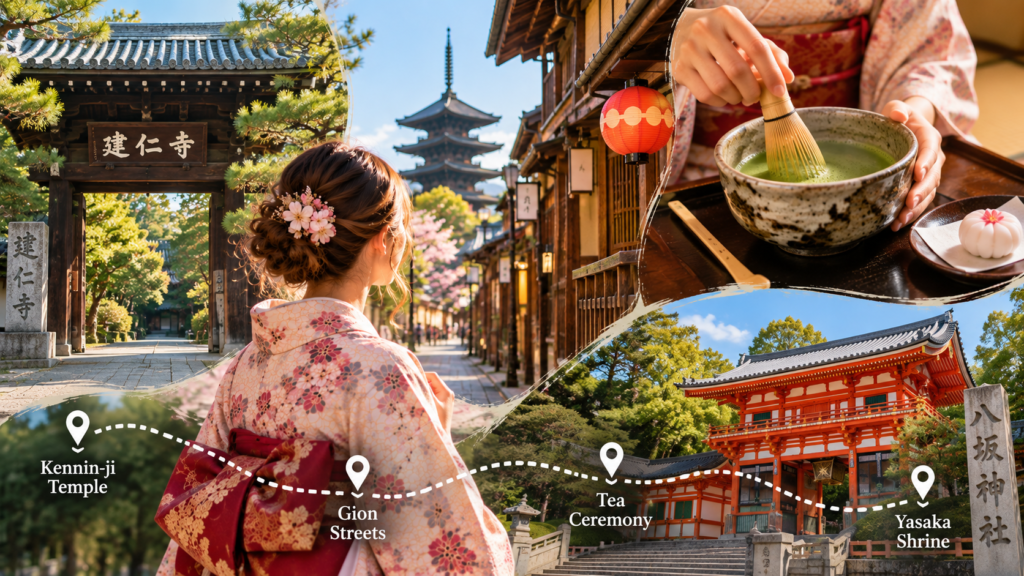
Only have half a day to explore Gion?
That is still enough time to experience some of the things that make Kyoto special.
Historic temples.
Traditional wooden streets.
Matcha and wagashi.
Japanese tea ceremony.
Shrines.
And the unique atmosphere of one of Kyoto’s most famous cultural districts.
The key is not trying to visit as many places as possible.
Instead, build your half-day Gion itinerary around places that are close enough to explore on foot and combine sightseeing with at least one traditional Japanese cultural experience.
In this guide, we introduce a practical 4–5 hour Gion itinerary for first-time visitors, starting near Gion-Shijo Station and continuing through Kennin-ji Temple, the historic streets of Gion, a Japanese tea ceremony, and Yasaka Shrine.
If you want to experience Kyoto rather than simply rush through it, this itinerary is for you.
Can You Explore Gion in Half a Day?
Yes.
Gion is one of the best areas in Kyoto for a half-day itinerary because many interesting places are concentrated within a relatively compact area.
Kyoto as a whole is much larger than many first-time visitors expect.
Kinkaku-ji.
Arashiyama.
Fushimi Inari.
Kiyomizu-dera.
Gion.
These famous destinations are not all next to each other.
Trying to visit too many parts of Kyoto in one day can mean spending a significant amount of time on buses, trains, and taxis.
Gion is different.
Within and around the district, you can experience:
Historic temples
Shrines
Traditional architecture
Matcha
Wagashi
Tea ceremony
Maiko and geiko culture
Japanese cuisine
Traditional streets
That makes Gion particularly suitable for travelers with limited time.
The Best Formula for Half a Day in Gion
For a balanced itinerary, think about three things:
See something.
Walk somewhere.
Experience something.
Visit a temple or shrine.
Walk through Gion’s traditional streets.
Then participate in Japanese culture through an activity such as tea ceremony.
This creates much more variety than simply moving between five different photo locations.
It also gives you something personal to remember.
A temple is something you see.
A street is somewhere you explore.
A tea ceremony is something you actually participate in.
Combining all three creates a satisfying half-day in Kyoto.
Half-Day Gion Itinerary at a Glance
Here is the basic route:
Gion-Shijo Station
↓
Kennin-ji Temple
↓
Walk through Gion
↓
Lunch
↓
Japanese Tea Ceremony
↓
Yasaka Shrine
Allow approximately 4 to 5 hours for the complete route.
All times below are examples, so adjust them according to current opening hours, reservations, weather, and your travel style.
10:00 AM — Start at Gion-Shijo Station
A convenient place to begin your Gion itinerary is Gion-Shijo Station.
The station sits beside the Kamo River and provides easy access to the historic Gion district.
Once you leave the station and begin walking east, the atmosphere gradually changes.
Modern Kyoto begins mixing with older architecture, restaurants, narrow streets, and traditional buildings.
Do not immediately rush toward the first attraction.
Part of the pleasure of exploring Gion is noticing what happens between destinations.
Look at the buildings.
Shop curtains.
Small lanes.
Restaurant entrances.
Traditional signs.
The walk itself is part of the experience.
10:15 AM — Visit Kennin-ji Temple
Your first major stop is Kennin-ji Temple.
Located in Gion, Kennin-ji is known as Kyoto’s oldest Zen temple.
Visiting a temple early in the itinerary gives you a quieter introduction to the cultural side of the neighborhood.
It can also provide useful context before a tea ceremony later in the day.
Zen Buddhism and Japanese tea ceremony are not the same tradition, but the historical development of Japanese tea culture was strongly connected with Zen monks and temples.
As tea culture evolved over the centuries, ideas associated with simplicity, attention, discipline, and aesthetics became important to the world of tea.
You do not need to understand this history before joining a tea ceremony.
But experiencing both during the same day can help you see connections between different parts of Japanese culture.
Suggested time: 45–60 minutes
11:15 AM — Walk Through Gion
After leaving Kennin-ji, spend some time simply walking.
This is not wasted time between attractions.
Walking is one of the main reasons to visit Gion.
Notice the traditional wooden buildings.
Lattice windows.
Stone-paved lanes.
Noren curtains.
Small shrines.
Tea houses.
Restaurants hidden behind simple entrances.
You will also see the contrast between historic architecture and modern life.
Gion is not a preserved museum district.
People continue to live and work here.
That is part of what makes the area interesting.
Suggested time: 30–45 minutes
Visiting the Hanamikoji Area Respectfully
Many first-time visitors want to explore the Hanamikoji area because of its traditional streetscape and association with maiko and geiko culture.
It is worth visiting, but remember one important thing:
Gion is not a theme park.
Some lanes and buildings are private.
People are working inside the neighborhood.
Always follow local signs and photography restrictions.
Do not enter private property.
Do not block narrow streets to take photographs.
And if you see a maiko or geiko, do not chase her or stop her from reaching her destination.
Responsible tourism is especially important in Gion because the culture visitors want to experience is still part of a living community.
11:45 AM–12:00 PM — Have Lunch in Gion
After your morning walk, stop for lunch.
There are many dining options around Gion, ranging from casual meals to traditional Kyoto cuisine and high-end restaurants.
If you have a tea ceremony reservation afterward, avoid scheduling lunch too tightly.
A restaurant may be busier than expected.
Food may take longer to arrive.
Gion’s streets may be crowded.
Allow enough time to enjoy your meal and reach your reservation comfortably.
If your tea ceremony includes wagashi and matcha, you may also prefer not to eat an extremely heavy meal immediately beforehand.
Suggested time: around 60 minutes
1:00 PM — Join a Japanese Tea Ceremony
This is the point where your Gion itinerary changes from sightseeing to participation.
Until now, you have been observing Kyoto.
You looked at a Zen temple.
You walked through historic streets.
During a tea ceremony, you become part of the experience.
Enter a tea room.
Sit on tatami.
Observe the host.
Learn about the utensils.
Enjoy Japanese wagashi.
Watch matcha being prepared.
Hold a bamboo chasen.
Whisk your own bowl of matcha.
Then taste the tea you prepared.
For many international visitors, this becomes one of the most memorable parts of a trip to Kyoto.
Suggested time: around 90 minutes
Why Tea Ceremony Works So Well in a Half-Day Gion Itinerary
There are several reasons.
First, it provides a break from walking.
Kyoto can be hot and humid in summer, cold in winter, and rainy at any time of year.
Spending part of the afternoon indoors makes a half-day itinerary much more comfortable.
But more importantly, tea ceremony brings together many things you encounter while exploring Kyoto.
Tatami.
Calligraphy.
Ceramics.
Bamboo.
Matcha.
Wagashi.
Seasonal aesthetics.
Hospitality.
Controlled movement.
The tea room brings different elements of Japanese culture together in one place.
That makes it particularly valuable when you have limited time.
Instead of trying to see another three attractions, you can spend that time understanding one cultural tradition more deeply.
Do You Need to Know Tea Ceremony Etiquette?
No.
Traditional Japanese tea ceremony includes many customs and forms of etiquette.
But visitors do not need to memorize them before joining a beginner-friendly experience.
You may wonder:
How should I sit?
When do I eat the wagashi?
How do I hold the tea bowl?
Do I need to turn the bowl?
How do I use the bamboo whisk?
A good beginner experience guides you through the relevant steps.
You are there to learn.
The goal is not to perform a perfect formal tea ceremony on your first attempt.
Approach the experience with curiosity and respect, and follow the host’s guidance.
2:30–3:00 PM — Walk Toward Yasaka Shrine
After the tea ceremony, continue through Gion toward Yasaka Shrine.
Walking again after sitting in the tea room creates a pleasant change of pace.
You may also notice the neighborhood differently after learning about Japanese tea culture.
Things that previously looked like decoration may have more meaning.
Traditional materials.
Seasonal displays.
Calligraphy.
Japanese sweets.
Small details become easier to notice.
3:00 PM — Visit Yasaka Shrine
Finish the main itinerary at Yasaka Shrine.
The shrine is closely connected with the history and identity of the Gion area.
It is also associated with Kyoto’s famous Gion Matsuri.
Visiting Yasaka Shrine after walking through Gion provides a natural conclusion to the route.
You have now experienced:
A Zen temple
Traditional streets
Japanese food
Tea ceremony
A Shinto shrine
all within a compact part of Kyoto.
Suggested time: 30–45 minutes
3:30 PM — Continue to Maruyama Park If You Have Time
If you still have time and energy, continue east into Maruyama Park.
The park is particularly famous during cherry blossom season, but it can also provide a pleasant place to slow down after sightseeing.
From here, you can continue deeper into Higashiyama or simply end your half-day itinerary.
Afternoon Half-Day Gion Itinerary
Not everyone wants to start sightseeing at 10:00 AM.
If you spend the morning somewhere else in Kyoto, you can begin Gion in the afternoon.
For example:
1:00 PM — Kennin-ji Temple
↓
2:00 PM — Walk through Gion
↓
3:00 PM — Japanese tea ceremony
↓
4:30 PM — Yasaka Shrine
↓
5:15 PM — Evening walk through Gion
↓
6:00 PM — Dinner
This version has one major advantage:
You can experience Gion as afternoon turns into evening.
The light changes.
Lanterns and restaurant entrances become more noticeable.
The neighborhood develops a different atmosphere.
Is Gion Better in the Morning or Afternoon?
Both can work.
Choose based on what you want to experience.
Morning
Morning is useful if you want to visit temples and begin before the busiest part of the day.
It can also be more comfortable during hot weather.
Afternoon
Afternoon works particularly well if you want to combine sightseeing with a scheduled cultural experience.
You can then stay for dinner or continue exploring as evening begins.
Evening
Gion has a beautiful atmosphere in the evening, but many temples and cultural attractions may already be closed.
For a first visit, it is usually better to begin earlier and allow your itinerary to naturally continue into the evening.
Can You See a Maiko During a Half-Day in Gion?
Possibly, but never build your itinerary around the assumption that you will.
Maiko and geiko work in Kyoto’s traditional entertainment districts, and visitors occasionally see them traveling between appointments.
But there is no guarantee.
If you do see a maiko or geiko, remember that she may be working.
Do not follow her.
Do not block her path.
Do not surround her for photographs.
If meeting a real maiko is an important part of your Kyoto trip, consider booking an organized experience that includes a real maiko.
This gives you a more appropriate and meaningful opportunity to encounter the culture.
How to Add a Maiko Experience to Your Gion Itinerary
If maiko culture is one of your main interests, you can replace the standard tea ceremony with a maiko tea ceremony experience.
Your itinerary could look like this:
Kennin-ji
↓
Gion walk
↓
Lunch
↓
Tea ceremony with a real maiko
↓
Yasaka Shrine
This allows you to combine two traditions closely associated with Kyoto:
Japanese tea culture and Kyoto’s maiko culture.
It also removes the need to wander through Gion hoping for a chance sighting.
How to Add Kimono to Your Half-Day Gion Itinerary
Wearing kimono can make exploring Gion feel even more immersive.
However, you need additional time for dressing.
A practical schedule might be:
9:00 AM — Kimono rental and dressing
↓
10:00 AM — Kennin-ji
↓
11:00 AM — Gion walk
↓
12:00 PM — Lunch
↓
1:00 PM — Tea ceremony
If you plan to wear kimono, remember that you may walk more slowly than usual, particularly if you are wearing traditional footwear.
Also check the return time required by the rental shop.
Do not schedule every activity too closely together.
How to Add Japanese Calligraphy
If you are particularly interested in traditional Japanese culture, another option is to combine calligraphy and tea ceremony.
Japanese calligraphy, or shodo, gives you a very different type of experience.
Hold a brush.
Dip it into black ink.
Practice Japanese characters.
Create your own piece.
Then move from brush and ink to matcha and bamboo whisk.
The two traditions complement each other well.
Calligraphy creates something physical that you can keep.
Tea ceremony centers on a moment that exists only while it is happening.
For travelers who prefer cultural activities over visiting many tourist attractions, this combination can be an excellent use of half a day.
A Rainy-Day Half-Day Gion Itinerary
Rain does not mean you need to cancel your Gion plans.
Instead, reduce the amount of outdoor walking and spend more time on indoor cultural experiences.
For example:
Kennin-ji
↓
Short Gion walk
↓
Lunch
↓
Tea ceremony or calligraphy
↓
Yasaka Shrine
Tea ceremony and calligraphy are especially useful because they are meaningful Kyoto activities rather than simply places to hide from the weather.
And traditional Kyoto streets can be particularly atmospheric in the rain.
A Summer Half-Day Gion Itinerary
Kyoto summers can be extremely hot and humid.
Avoid planning several hours of uninterrupted outdoor sightseeing during the hottest part of the afternoon.
A more comfortable schedule is:
Morning — Temple and Gion walk
↓
Lunch
↓
Early afternoon — Indoor tea ceremony
↓
Late afternoon — Outdoor sightseeing again
This places your indoor cultural experience during the hottest part of the day.
Stay hydrated and allow more breaks than you think you need.
A Winter Half-Day Gion Itinerary
Winter offers a different side of Kyoto.
Cold weather can make long outdoor walks uncomfortable, but it also makes the contrast of entering a tea room particularly enjoyable.
Walk through Gion.
Step inside.
Sit in a traditional room.
Receive a bowl of warm matcha.
Then continue toward Yasaka Shrine.
Alternating outdoor sightseeing with indoor experiences can make a winter itinerary much more comfortable.
Can You Combine Kiyomizu-dera and Gion in Half a Day?
Yes, but you need to be selective.
Kiyomizu-dera is relatively close to the Gion and Higashiyama areas, so many visitors naturally want to combine them.
However, an itinerary containing:
Kiyomizu-dera
Sannenzaka and Ninenzaka
Yasaka Pagoda area
Yasaka Shrine
Gion
Kennin-ji
and a tea ceremony
can become rushed if you only have four hours.
If you want to include Kiyomizu-dera and a cultural experience, consider allowing at least 5–6 hours, and preferably longer.
Do not measure the quality of your Kyoto trip by the number of attractions you checked off.
Three Tips for Planning a Half-Day in Gion
1. Book Your Timed Experience First
If you want to join a tea ceremony, calligraphy experience, or maiko experience, choose your reservation time first.
Then build the rest of your itinerary around it.
Temples and streets are relatively flexible.
A reserved experience is not.
2. Leave Extra Walking Time
Places can look extremely close on a map.
But crowded streets, traffic lights, photographs, shopping, and simply getting slightly lost can all add time.
Leave a little space between activities.
3. Do Not Try to See Everything
Half a day is enough to experience Gion.
It is not enough to experience everything in Gion.
Choose one temple.
One shrine.
Some time for walking.
One meaningful cultural experience.
That is already an excellent Kyoto itinerary.
Add THE TEA CEREMONY GION Orizuruya to Your Gion Itinerary
If you want to include Japanese tea culture in your half-day itinerary, THE TEA CEREMONY GION Orizuruya is conveniently located in Gion.
It is approximately 4 minutes on foot from Gion-Shijo Station and 7 minutes from Kyoto-Kawaramachi Station.
This makes it easy to build a walking route such as:
Kennin-ji → Gion streets → THE TEA CEREMONY GION Orizuruya → Yasaka Shrine
During the standard tea ceremony experience, guests can learn about Japanese tea culture, observe the host preparing matcha, enjoy Kyoto wagashi, and then use a bamboo chasen to whisk matcha themselves.
For travelers interested in multiple Japanese traditions, Orizuruya also offers experiences combining Japanese calligraphy and tea ceremony.
And for visitors particularly interested in Kyoto’s traditional entertainment culture, a maiko tea ceremony provides an opportunity to experience tea culture together with a real maiko.
Instead of adding another sightseeing spot to your itinerary, you can use that time to participate in the culture that brought you to Kyoto in the first place.
Frequently Asked Questions About a Half-Day Gion Itinerary
Is half a day enough for Gion?
Yes.
Around 4–5 hours is enough to visit a temple, explore the historic streets, join a tea ceremony, and visit Yasaka Shrine without traveling long distances across Kyoto.
What should I prioritize in Gion if I only have half a day?
For a first visit, a balanced itinerary could include Kennin-ji Temple, a walk through Gion, one cultural experience such as tea ceremony, and Yasaka Shrine.
Can I explore Gion on foot?
Yes.
Many major sights and cultural experiences in central Gion are within walking distance of one another.
Should I book a tea ceremony in advance?
Advance booking is recommended if you want a particular date and time, especially during busy travel seasons.
Can I visit Gion and Kiyomizu-dera in half a day?
Yes, but adding Kiyomizu-dera makes the itinerary significantly busier.
If you also want to join a tea ceremony, allowing 5–6 hours or more will create a more comfortable schedule.
Can I see a maiko in Gion?
You may see one, but it is never guaranteed.
If meeting a real maiko is important to you, booking an organized maiko cultural experience is a more reliable and respectful option.
Is Gion good on a rainy day?
Yes.
You can combine shorter outdoor walks with indoor activities such as tea ceremony and Japanese calligraphy.
Is Gion-Shijo Station a good starting point?
Yes.
Gion-Shijo Station provides convenient access to central Gion, the Kamo River, Kennin-ji area, cultural experiences, and the route toward Yasaka Shrine.
Half a Day Is Enough to Experience Kyoto—If You Slow Down
When you only have half a day, it is tempting to move faster.
Add another temple.
Add another shrine.
Take another photograph.
Visit another famous street.
But Gion rewards the opposite approach.
Slow down.
Enter a Zen temple.
Notice the wooden buildings.
Walk through the narrow streets.
Taste wagashi.
Enter a tea room.
Pick up a bamboo whisk.
Make your own matcha.
Visit a shrine.
Half a day may not be enough to see everything.
But it is enough to create a meaningful experience of Kyoto.
Do not simply pass through Gion. Give yourself time to experience it.