

Best Things to Do in Kyoto on a Rainy Day: Indoor Cultural Experiences
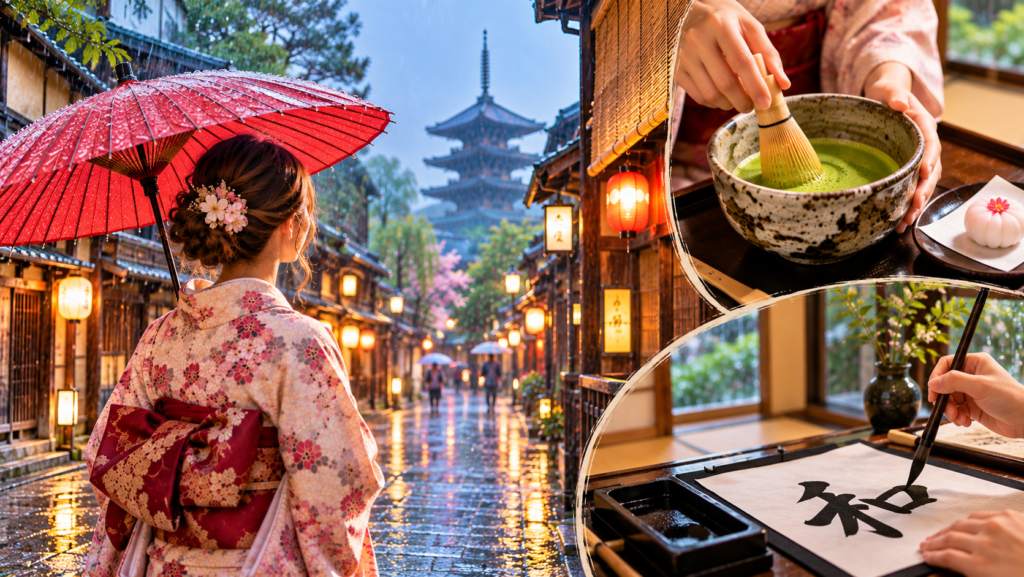
You planned the perfect trip to Kyoto.
Temples.
Shrines.
Traditional streets.
Maybe a kimono walk through Gion.
Then you check the weather forecast.
Rain.
So, what should you do in Kyoto when it rains?
The good news is that a rainy day does not have to ruin your Kyoto itinerary.
Kyoto is famous for outdoor sightseeing, but some of the city’s most memorable experiences happen indoors.
Japanese tea ceremony.
Calligraphy.
Matcha and wagashi.
Traditional crafts.
Museums.
Japanese cuisine.
And even experiences with Kyoto’s maiko culture.
Rain can also transform the city itself.
Wet stone streets, temple gardens, wooden machiya townhouses, umbrellas, and reflections from lanterns can give Kyoto a completely different atmosphere.
The key is not trying to follow your sunny-day itinerary exactly as planned.
Instead, combine short periods of outdoor sightseeing with meaningful indoor cultural experiences.
Here are some of the best things to do in Kyoto on a rainy day.
Is Kyoto Worth Visiting in the Rain?
Absolutely.
Many first-time visitors imagine Kyoto mainly as an outdoor destination.
Kiyomizu-dera.
Fushimi Inari.
Arashiyama.
Gion.
Temple gardens.
Traditional streets.
These are all wonderful places to explore, but Kyoto is much more than its scenery.
The city is also one of Japan’s great centers of traditional culture.
Tea ceremony.
Calligraphy.
Wagashi.
Traditional crafts.
Japanese cuisine.
Buddhist culture.
Kimono.
Ceramics.
Many of these experiences can be enjoyed indoors.
Instead of thinking:
“What can I still do despite the rain?”
try asking:
“What part of Japanese culture can I experience today?”
That small change can completely reshape your rainy-day itinerary.
The Best Rainy-Day Strategy: Combine Indoor and Outdoor Kyoto
You do not necessarily need to spend the entire day indoors.
Unless the weather is severe, one of the best approaches is to alternate between outdoor sightseeing and indoor activities.
For example:
Temple
↓
Lunch
↓
Tea ceremony
↓
Short walk through Gion
↓
Calligraphy, museum or café
This keeps you from spending several hours continuously walking in the rain while still allowing you to experience the atmosphere of Kyoto.
It also gives your day more variety.
1. Experience a Japanese Tea Ceremony
One of the best indoor activities in Kyoto is a Japanese tea ceremony.
Tea ceremony works particularly well on a rainy day because it is more than simply an indoor alternative to sightseeing.
The atmosphere can actually feel especially appropriate when it rains.
The sound of rain outside.
Tatami under you.
A ceramic tea bowl.
Steam rising from hot water.
The green color of matcha.
Seasonal wagashi.
The quiet movements of the host.
Instead of rushing between tourist attractions, you spend time focusing on small details.
For many visitors, this becomes one of the most memorable cultural experiences of their trip.
What Happens During a Tea Ceremony Experience?
The exact program depends on the venue, but a beginner-friendly tea ceremony may include opportunities to:
Learn about Japanese tea culture.
Observe traditional tea utensils.
Watch the host prepare matcha.
Enjoy Japanese wagashi.
Drink matcha.
Learn basic tea ceremony etiquette.
And prepare matcha yourself using a bamboo chasen.
You do not need previous knowledge of tea ceremony.
Beginner-friendly experiences are designed to introduce visitors to the culture while guiding them through the necessary steps.
Why Tea Ceremony Is Especially Good on a Rainy Day
There is a practical reason:
You are indoors.
But there is also a cultural reason.
Japanese tea culture places great importance on the atmosphere of a particular moment.
The season.
The utensils.
The flowers.
The sweets.
The weather.
The guests.
The host.
A rainy day is not necessarily something that needs to be ignored.
It can become part of the experience.
The rain you were disappointed to see in the morning may feel completely different when you are sitting inside a quiet tea room with a bowl of matcha.
2. Try Japanese Calligraphy
Another excellent indoor activity is Japanese calligraphy, known as shodo.
Calligraphy allows you to experience Japanese writing as both language and visual art.
You hold a brush.
Dip it into black ink.
Practice individual strokes.
Choose a kanji.
Then create your own piece of calligraphy.
International visitors often enjoy selecting a character based on its meaning.
For example:
愛 — love
夢 — dream
心 — heart / mind
和 — harmony
幸 — happiness
The finished work can also become a personal souvenir from your trip.
If rain prevents you from taking the outdoor photographs you expected, creating something yourself can become an entirely different kind of travel memory.
3. Combine Calligraphy and Tea Ceremony
If the weather forecast shows several hours of rain, consider spending more time on cultural activities rather than moving repeatedly between attractions.
Tea ceremony and calligraphy work particularly well together.
Calligraphy uses:
brush and ink.
Tea ceremony uses:
matcha and a bamboo whisk.
They are different traditions, but both encourage concentration and attention to movement.
You learn how to handle traditional tools.
You slow down.
You pay attention to details.
And you experience Japanese aesthetics through actions rather than simply observing them.
For travelers with limited time in Kyoto, combining the two can be an efficient way to experience more than one Japanese tradition without spending much of the day traveling in bad weather.
4. Enjoy Matcha and Wagashi
A rainy afternoon is also a good excuse to slow down and enjoy Kyoto’s famous tea culture.
You will find many ways to enjoy matcha throughout the city.
Matcha parfait.
Matcha ice cream.
Matcha latte.
Traditional matcha.
Japanese sweets.
For a deeper cultural experience, try enjoying matcha together with traditional wagashi.
In tea ceremony, wagashi is generally eaten before drinking matcha.
The sweetness prepares your palate for the tea’s bitterness and umami.
Traditional wagashi may also reflect the season through its colors, ingredients, shapes, and names.
A small sweet can represent cherry blossoms in spring, autumn leaves later in the year, or other seasonal themes.
This makes the combination of wagashi and matcha more than simply dessert and tea.
It can become a small expression of the Japanese season.
5. Visit a Museum
Museums are an obvious rainy-day choice, but in Kyoto they can also provide valuable context for the places you visit later.
Depending on your interests, you can explore Japanese history, art, crafts, manga, or other aspects of Japanese culture.
A simple rainy-day itinerary might be:
Museum in the morning
↓
Lunch
↓
Tea ceremony in the afternoon
This gives you several hours indoors while still creating a day centered on Kyoto’s culture rather than simply escaping the weather.
Check current exhibition schedules and opening hours before visiting.
6. Try a Traditional Kyoto Craft
Kyoto has a long history of craftsmanship.
Depending on current workshops and availability, visitors may find experiences related to areas such as:
Ceramics
Textiles
Bamboo crafts
Japanese paper
Fans
Incense
Traditional decorative arts
A workshop changes your role from shopper to participant.
Instead of simply buying a souvenir made in Kyoto, you create something during your time in Kyoto.
That makes craft workshops especially useful on a rainy day.
You stay indoors, learn about Japanese culture, and leave with something connected to the experience.
7. Make Japanese Food Part of the Experience
On sunny days, travelers often rush through lunch because they want to reach the next attraction.
Rain gives you a reason to slow down.
Instead of treating lunch as a break between sightseeing spots, make food part of the itinerary.
Depending on your interests and budget, Kyoto offers many possibilities.
Traditional Kyoto cuisine.
Tofu dishes.
Soba.
Sushi.
Seasonal Japanese cuisine.
Wagashi.
Japanese tea.
A longer lunch followed by a tea ceremony can turn a rainy afternoon into a cultural experience rather than a compromised sightseeing day.
8. Visit a Temple in the Rain
Not everything needs to move indoors.
Some Kyoto temples can be particularly beautiful in rainy weather.
Wet stone.
Deep green moss.
Garden plants.
Wooden architecture.
Reflections.
Mist.
The rain can intensify colors and create a quieter atmosphere.
If the weather is manageable, choose one temple rather than trying to visit many outdoor attractions.
Spend some time there.
Then move indoors for your next activity.
This is usually more enjoyable than spending several hours continuously walking through heavy rain.
9. Walk Through Gion in the Rain
Gion has a very different atmosphere when it rains.
Wet stone streets reflect the surrounding buildings and lights.
Traditional wooden machiya appear behind umbrellas.
Noren curtains move outside shops.
The neighborhood can feel quieter and more atmospheric than it does under bright sunshine.
You do not need to walk for hours.
Try:
short walk → indoor experience → short walk
instead.
That allows you to enjoy rainy Kyoto without becoming exhausted and soaked.
10. Experience Kyoto’s Maiko Culture Indoors
Many international visitors come to Gion hoping to see a real maiko.
But walking through the streets does not guarantee that you will see one—whether it is raining or not.
And if you do encounter a maiko or geiko traveling to work, she should not be chased, blocked, or surrounded for photographs.
If experiencing authentic maiko culture is important to you, an organized indoor cultural experience involving a real maiko can be a much better option.
This is particularly convenient on rainy days.
Rather than wandering outside hoping for a chance encounter, you can experience part of Kyoto’s traditional entertainment culture in an appropriate setting.
Can You Wear Kimono in Kyoto When It Rains?
Yes, but think carefully about the weather conditions.
Light rain may be manageable.
Heavy rain creates more problems.
The hem of the kimono may become wet.
Traditional footwear can be more difficult to walk in.
You will need to carry an umbrella.
Outdoor photography becomes harder.
If wearing kimono is important to you, consider reducing the amount of outdoor walking.
For example:
Kimono dressing
↓
Short Gion walk
↓
Indoor tea ceremony
↓
Lunch or café
This lets you enjoy the experience without spending several hours walking through the rain.
What Not to Do on a Rainy Day in Kyoto
One of the easiest ways to make a rainy day exhausting is to follow an outdoor itinerary exactly as originally planned.
Imagine this:
Kiyomizu-dera.
Sannenzaka.
Ninenzaka.
Yasaka Shrine.
Gion.
Another neighborhood.
Another outdoor attraction.
All while carrying an umbrella and walking in wet shoes.
By the afternoon, you may be too tired to enjoy any of it.
Instead, reduce the number of places.
Change:
five sightseeing spots
into:
two sightseeing spots + one cultural experience.
You may actually remember the day more clearly.
A Rainy-Day Half-Day Itinerary in Gion
If you want to experience Kyoto without spending the whole day outside, Gion is a convenient area because several cultural attractions and experiences are relatively close together.
Here is one example.
10:00 AM — Kennin-ji Temple
Begin at Kennin-ji, a historic Zen temple located in Gion.
Rain can create a particularly quiet atmosphere around temple architecture and gardens.
Take your time rather than treating the temple as another quick photo stop.
↓
11:00 AM — Short Walk Through Gion
If the rain is manageable, spend around 30 minutes exploring Gion.
Notice the traditional buildings, narrow streets, and wet stone surfaces.
There is no need for a long walk.
↓
11:30 AM — Lunch
Move indoors and enjoy a relaxed lunch.
A rainy day is a good opportunity to stop rushing.
↓
1:00 PM — Japanese Tea Ceremony
Spend the early afternoon inside a tea room.
Learn about Japanese tea culture.
Watch matcha being prepared.
Enjoy wagashi.
Then pick up a bamboo whisk and prepare your own bowl of matcha.
↓
2:30 PM — Calligraphy, Museum or Café
If the rain continues, stay indoors.
Try Japanese calligraphy, visit a museum, or enjoy more Japanese tea.
Combining tea ceremony and calligraphy in one location can also reduce unnecessary travel.
↓
Around 4:00 PM — Yasaka Shrine
If the rain becomes lighter, continue toward Yasaka Shrine.
If conditions remain unpleasant, there is no need to force another outdoor activity into your schedule.
What to Do Near Kyoto Station When It Rains
If the weather is particularly bad and you want to minimize travel, the Kyoto Station area offers plenty of practical options.
Shopping.
Restaurants.
Souvenirs.
Indoor facilities.
It is an easy place to spend several hours without getting wet.
However, if experiencing traditional Kyoto culture is one of the main reasons for your trip, consider traveling to an area such as Gion for one reserved cultural activity.
Even one tea ceremony or calligraphy experience can make the day feel distinctly Kyoto rather than simply a day spent avoiding rain.
Book One Indoor Experience First
One of the easiest ways to organize a rainy day in Kyoto is to choose one fixed indoor activity first.
For example:
Book a tea ceremony at 1:00 PM.
Now you have an anchor for your day.
You can visit a temple in the morning.
Have lunch nearby.
Attend the tea ceremony.
Then decide what to do afterward based on the weather.
This is much easier than creating a complicated itinerary that depends on perfect conditions.
Rainy-Day Tea Ceremony in Gion at THE TEA CEREMONY GION Orizuruya
Located in Kyoto’s historic Gion district, THE TEA CEREMONY GION Orizuruya offers indoor Japanese cultural experiences suitable for international visitors and beginners.
Orizuruya is approximately 4 minutes on foot from Gion-Shijo Station and 7 minutes from Kyoto-Kawaramachi Station, making it easy to combine with sightseeing around Gion.
During the tea ceremony experience, guests can learn about Japanese tea culture, observe the host preparing matcha, enjoy Kyoto wagashi, and use a traditional bamboo chasen to whisk matcha themselves.
For travelers who want to spend more time indoors, experiences combining Japanese calligraphy and tea ceremony are also available.
Visitors interested in Kyoto’s traditional entertainment culture can also explore experiences combining a real maiko and tea ceremony.
So if rain changes your Kyoto itinerary, you do not have to think:
“Our sightseeing day is ruined.”
Instead, make it the day you experience Japanese culture from the inside.
Frequently Asked Questions About Rainy Days in Kyoto
What are the best things to do in Kyoto on a rainy day?
Tea ceremony, Japanese calligraphy, museums, traditional craft workshops, matcha and wagashi, Japanese cuisine, and other indoor cultural experiences are good options.
You can also combine them with shorter visits to temples or historic neighborhoods.
Is Gion worth visiting in the rain?
Yes.
Gion’s traditional streets can be particularly atmospheric in rainy weather.
Instead of walking for several hours, combine short walks with indoor cultural activities.
Can I do a tea ceremony when it rains?
Yes.
Tea ceremony is held indoors and is one of the easiest traditional Kyoto experiences to include in a rainy-day itinerary.
What indoor activities can I do in Kyoto?
Options include tea ceremony, Japanese calligraphy, museums, craft workshops, food experiences, matcha and wagashi, and other cultural activities.
Availability varies, so check and reserve specific experiences in advance when necessary.
Can I wear kimono in Kyoto when it rains?
Yes, particularly in light rain, but heavy rain can make walking uncomfortable and may wet the kimono and footwear.
Consider combining a short outdoor walk with indoor activities.
Can I see a maiko on a rainy day?
You might see a maiko or geiko in Gion, but it is never guaranteed.
If meeting a real maiko is important to you, consider booking a cultural experience that includes a maiko rather than relying on a chance encounter.
Should I cancel my outdoor Kyoto itinerary if it rains?
Not necessarily.
If the rain is manageable, choose one or two outdoor locations and combine them with indoor experiences rather than spending the entire day outside.
Where should I go in Kyoto when it rains?
There is no single best area, but Gion works particularly well for travelers interested in traditional Kyoto culture because temples, historic streets, food, tea culture, and indoor cultural experiences can be combined within a relatively compact area.
Rain Can Change Your Kyoto Trip—Without Ruining It
Seeing rain in the forecast can be disappointing.
Especially when you have traveled a long way to visit Kyoto.
But you do not control the weather.
You do control how you experience the city.
Listen to rain from inside a tea room.
Drink warm matcha.
Taste seasonal wagashi.
Hold a calligraphy brush.
Walk through wet streets in Gion.
Notice the deeper colors of a temple garden.
Instead of trying to recreate the sunny Kyoto itinerary you originally imagined, experience the version of Kyoto that exists that day.
Sometimes the unexpected day becomes the one you remember most.
When it rains in Kyoto, slow down, step inside, and experience Japanese culture.